Monday, 10 September 2012

Review: THE SPIRIT LENS

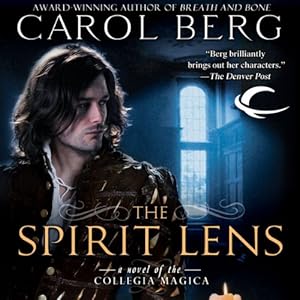
The Spirit Lens by Carol Berg
Read by David DeVries
Book 1 of The Soul Mirror (Collegia Magica, #1) series
Genre: renaissance, fantasy, murder mystery, investigative suspense
Format: paperback, unabridged audiobook (MP3)

About The Spirit Lens:
In a kingdom on the verge of a grand renaissance, where natural science has supplanted failing sorcery, someone aims to revive a savage rivalry...

For Portier de Savin-Duplais, failed student of magic, sorcery's decline into ambiguity and cheap illusion is but a culmination of life's bitter disappointments. Reduced to tending the library at Sabria's last collegia magica, he fights off despair with scholarship. But when the king of Sabria charges him to investigate an attempted murder that has disturbing magical resonances, Portier believes his dreams of a greater destiny might at last be fulfilled.

As the king's new agente confide, Portier - much to his dismay - is partnered with the popinjay Ilario de Sylvae, the laughingstock of Sabria's court. Then the need to infiltrate a magical cabal leads Portier to Dante, a brooding, brilliant young sorcerer whose heretical ideas and penchant for violence threaten to expose the investigation before it's begun. But in an ever-shifting landscape of murders, betrayals, old secrets, and unholy sorcery, the three agentes will be forced to test the boundaries of magic, nature, and the divine...
Source: Info in the About The Spirit Lens was taken from GoodReads at http://www.goodreads.com/book/show/6678976-the-spirit-lens on 21/08/2012.

Review:
I bought this book simply because it got Carol Berg's name on it. I am an old Carol Berg fan and absolutely love her Lighthouse doulogy. I wanted to enjoy more of that kind of wonderful reading time... thus the purchase of this series... But, I've had this book in my TBR shelves for the longest time. I tried picking it up a few times, however I just couldn't get into the story. After sometime I finally decided to cheat and download the audio version. I wanted to persevere with this book because based on my previous experience with this author, her beginnings are not always smashing. I had to plod through Book 1 of the Lighthouse doulogy before I could enjoy the wonderful reading time of Book 2! So I decided to cheat... listened to the audiobook.

Right off at the start, the king hired a librarian who is also a failed magician with no investigative experience or knowledge, to investigate the magical assassination to his royal person. At the same time the king paired the librarian to a less-than-useless and bumbling pompous jay. It made me think that the king did not really want the root of the magical assassination discovered. However, I was pleasantly surprised to find out that, that was just one of the many twists of the plot. Once I got into the story I appreciated the unfolding of the plot and the unexpected turns it took! Kudos for the twisty plot! So our hero is a librarian-turned-investigator. He never claimed to be a trained professional so I forgave his ineptness at times, even as it annoyed me. It was after all, in keeping with his character. I am also looking forward to reading further into this series to find out how the dice would roll with the wild card character who is Master Mage Dante would turn out to be... I sincerely hope he would be one of the good guys instead of one of the bad guys... 'coz, it'll break my heart... Another kudos for the character development! All in all, this book was quite a good start for Carol Berg.
CymLowell
Empirical Evaluation:
Story telling quality = 4
Character development = 4.5
Story itself = 4
Ending = 4
World building = 4
Cover art = 4.5
Pace = N/A (17 hours & 18 minutes)
Plot = 4.5
Narrator = 4.5

Overall Rating: 4.5 out of 5 cherries

Friday, 7 September 2012

Guest Post: HEATHER FROST

Villains Are People Too
I’ve got two short scenes for you:
The middle aged woman drummed her heavily scarred fingers against her enormous mahogany desk, extremely impatient. Her two massive killer dogs in the corner were bristling and ready to attack the first unfriendly to step through the office door. This underground facility was the perfect lair for her to safely carry out her nefarious plans of revenge. Havoc would be wreaked on the world this day!

And scene two:
The middle aged woman strummed her long fingers over the guitar strings, her expression thoughtful as the notes drifted indistinctly into the air. Sitting on the grass under the springtime sun, she could hear the shrieking sounds of children running and playing in the park, enjoying a quiet afternoon. She smiled just a little, thinking that if things had gone differently, she might have a child of her own now.

What do these scenes have in common? Aside from being incredibly cheesy? Well, why prolong the obvious: both of these scenes depict a villain. The first scene is too cliché for words. The second might be overdone as well, but these two scenes illustrate the first and most important rule in creating a believable villain: the villain cannot see himself as a villain.

A successful villain doesn’t think to themselves, “wow, I’m an incredibly terrible person!” Instead, a strong villain may even believe himself to be the hero. Now, that doesn’t necessarily mean that a good villain can’t recognize they’re doing something “bad”. This just means that they have to believe they’re bringing about the greater good, even if it means taking morally wrong action. In order to do this successfully, you need to follow the second rule, which is strong motivation.

Figuring out a villain’s motivation is supremely important, because without that they will not be remotely believable. They have to have a good reason for doing what they’re doing. Maybe that means the reader and hero will sympathize with the villain, and maybe that just means that the villain has justified his actions, so he thinks he’s got a good reason for doing what he’s doing. That’s up to the writer to decide. Regardless of which one an author chooses, strong motivation leads us to the third rule of creating a successful villain: the necessity of positive traits.

In order to avoid flat characters, (“flat” meaning characters without well-rounded personalities,) heroes need flaws, and villains need attributes. Now I’m not saying a villain needs to donate to charities, or volunteer in the community (although I suppose he could). I’m talking more about characteristics, or talents, that are desirable. Maybe your villain can play the accordion, or the piano. Maybe he paints, or golfs. Maybe he’s patient, or optimistic. He may even follow traffic laws, and choose to recycle. But he can’t be ALL BAD. Just like a hero can’t be ALL GOOD. For a hero to be relatable, and truly lovable to the reader, he needs some flaws. Short temper, low self-esteem. A scar on their face, or a mole on their nose. Maybe the hero was a terrible bully as a child, and forgets his best friend’s birthday. But a hero loses relate-ability the minute he becomes perfect, the same way a villain loses credibility the moment he’s described as completely abominable.

A good, strong villain is just as important as a good, strong hero. So next time you’re brainstorming about villain crafting, keep these three important rules. And good luck writing!
Demons by Heather Frost
Book 2 of the Seers series
 About Demons:
Kate’s life is far from normal. She can see auras, her boyfriend is immortal, and her powers make her a target. But now that the Demon Lord is hunting her, things are about to go from dangerous to truly deadly. Packed with action, mind-blowing plot twists, and characters you can’t get enough of, this is a fast-paced, heart-pounding read from cover to cover.
Source: Info in the About Demons was taken from GoodReads at http://www.goodreads.com/book/show/13695982-demons on 05/08/2011.

Seers by Heather Frost
Book 1 of the Seers series
About Seers:
For Kate Bennet, surviving the car wreck that killed her parents means big changes and even bigger problems. As she begins to see auras and invisible people, Kate must learn to trust Patrick O'Donnell, a handsome Guardian, or risk her life being overrun with Demons. She soon realizes that both she and her heart are in big-time trouble.
Source: Info in the About Seers was taken from GoodReads at http://www.goodreads.com/book/show/11837058-seers on 05/08/2011.

Tuesday, 4 September 2012

Review: GLORY IN DEATH

Glory In Death by JD Robb
Book 2 of the In Death series
Narrated by Cristine McMurdo-Wallis
Genre: SciFi murder mystery, police investigation, crime fiction
Format: paperback, audiobook CD

About Glory In Death:
It is 2058, New York City. In a world where technology can reveal the darkest of secrets, there's only one place to hide a crime of passion-in the heart.

Even in the mid-twenty-first century, during a time when genetic testing usually weeds out any violent hereditary traits before they can take over, murder still happens. The first victim is found lying on a sidewalk in the rain. The second is murdered in her own apartment building. Police Lieutenant Eve Dallas has no problem finding connections between the two crimes. Both victims were beautiful and highly successful women. Their glamorous lives and loves were the talk of the city. And their intimate relations with men of great power and wealth provide Eve with a long list of suspects-including her own lover, Roarke.
Source: Info in the About Glory In Death was taken from GoodReads at http://www.goodreads.com/book/show/268601.Glory_in_Death on 26/02/2012.

Review:
There are two main things I like about this series: One, is that Eve, our main protagonist, is NOT too stupid to live (TSTL). Second, there is a layering of plot. Or maybe I'm just reading too many Charlaine Harris books.

Like Book 1, I borrowed this audiobook from the Library even though I already have the paperback edition in my TBR shelf. I am glad that I have the paperback because I find Cristine McMurdo-Wallis' narration slightly confusing at times. She sometimes does not give out any indication in her voice, in an inflection of tone or pauses or diction or whatever, that the characters talking has swapped. Or that chapters has changed. Or the scene has changed or something. Sometimes this requires rewinds and a few re-listens. When that happens, I am ever so glad to have the paperback to fall back on.

The baddest downer with Book 1 was that it was slightly predictable. It seems that it is also true with this book (Book 2). However, the road to get there is quite twisty that I doubted once, before going back to my original suspect. And damn if I was right!! Hopefully it would not be so predictable in the next book because I kinda like this series. And like I said, the plot is not "2D" but complex with layers of sub-plots with an over-arc-ing main plot which scores lots of brownie points with me!

Empirical Evaluation:
Story telling quality = 3.5
Character development = 4
Story itself = 3.5
Ending = 3
World building = 4
Cover art = 2
Pace = 11-hours audiobook/9 CDs
Plot = 4
Narrator = 2

Overall Rating: 3.5 out of 5 cherries


Thank you to the RCT Library for letting me borrow this audiobook!!

FTC Disclosure:
This audiobook was borrowed from the library. The paperback edition was bought by private money. No money received for this review.

Sunday, 2 September 2012

Guest Post: SCI-FI BLOGGERS

Dystopian Societies: Are They Just Another Phase?Dystopia
So far my summer has consisted of a lot of work and a lot of reading. Since getting out of school I have read INSURGENT, the second book in Veronica Roth’s Divergent Series, I finished MATCHED, the first book in Ally Condie’s Matched Trilogy, and finished the first two books in Lauren Oliver’s Delirium Series, DELIRIUM and PANDEMONIUM.

The Divergent Series is about an isolated society (spoiler: set up by the government as a test) in the United States. The society is broken up into five factions: Abnegation, Dauntless, Amity, Erudite, and Candor. Each person is born into a certain subgroup, but when a citizen turns sixteen they are tested and have the opportunity to choose to stay in their original faction or switch, depending on whether they had an affinity for another faction. Eventually, of course, the society finds weaknesses in their factions and a rebellion begins. In the Matched Trilogy, in an attempt to keep society controlled and moderated, the government matches you with the person you are to be married with, matches you to your job, and even controls your food intake. Then, in the Delirium Series, much like Matched, the government tests you and matches you with a job and a mate. However, the government in this society took it one step farther than matched. In order to control the emotions and behavior of individuals, at the age of eighteen each citizen has invasive brain surgery that removes the emotion of love.

After thinking about what I’ve read this summer I realized that they all had something in common: they were Dystopian YA Bestsellers. Over the past few months I’ve realized that the large success of The Hunger Game has triggered a new trend in YA literature, and in pop culture in general. It’s not that dystopian novels haven’t been there before, but they are gaining popularity in the mainstream media nowadays. Take for example two of the books I mentioned before, Divergent and Delirium, both of those books are currently in the process of being adapted into films and I wouldn’t be surprised if there were more dystopian novels currently in line to become a movie. People just can’t seem to get enough of this literature right now, but what about it is so appealing to the general public? What is it that’s so appealing to me? Apparently I’m just as sucked into as the rest of the world. Give me a book where the world was in turmoil and an oppressive government has to take over, only to eventually be overthrown by a group of renegades. Then toss in a little violence and a little romance, which they always do, and you’ve got me hooked.

My initial reaction was that this was just another trend in literature, and pop culture. We had the time of the wizards, we are just about vampired out (except I won’t deny that I’m thoroughly sucked into the new season of True Blood), and the people just needed something new to be obsessed with. With the first Hunger Games film being so wildly successful it seems the people really have found their new form of entertainment. This is how the entertainment business generally works. They squeeze the life out of a fad until there is nothing left but the skeleton of what used to be their best seller. Then we as fans try and shake off our shame for helping society ruin yet another idea that used to be so fresh and new, and wait until they bring us something new to feast on.

However, there is something more to the dystopian novels than just a form of entertainment. I believe its popularity partially stems from the fact that these stories don’t seem like they could be far off from the reality of our future. Maybe people cling so hard to these novels to try and reassure themselves that the world will never get this bad, or maybe even to try and convince themselves that the present isn’t so bad. I mean, hey, at least we aren’t sending our kids into an arena to fight to the death (people willingly sign up for the army so that doesn’t count, right?), and we aren’t performing outrageous brain surgeries on eighteen year olds that remove the ability to love. Clearly we’re all good, right? But the fact is that even though aspects of these novels seem completely outrageous and so far beyond us that they seem to be science fiction, there are main themes that run in them that can be seen in present day. For example, in the novels the governments have almost infinite control over the lives of their citizens, and that is a real fear for some people today. So, while the government isn’t implementing a bill for mandatory brain surgery, the government of New York does plan to ban the purchase of large soft drinks—so if you want to ever have your supersized Coke at McDonalds in NY again, I suggest you go get one soon. In addition, each book has a rebel group that has been working underground to overthrow the oppressive governments. If you have been watching the news at all you will know that is not far off from what has been going on in present day, especially in countries in Africa.

I believe what makes these novels so popular are their ability to be relatable while still maintaining a comfortable distance from reality. This trend in pop culture is just starting to pick-up and doubt it will slow down any time soon. What are your thoughts on dystopian societies, just another trend or do its roots go deeper than that?
This is a guest post by Sci-Fi Bloggers. Sci-Fi Bloggers is an online magazine covering all things science fiction and fantasy: movies, TV, books, video games, comics and more.

Friday, 31 August 2012

Review: DESTINED FOR AN EARLY GRAVE

Destined For An Early Grave by Jeaniene Frost
Narrated by Tavia Gilbert
Book 4 of the Night Huntress Novel series
Genre: urban fantasy
Format: paperback, audiobook

About Destined For An Early Grave:
Hopes for a perfect Paris holiday are dashed when half-vampire Cat Crawfield begins having visions of a vampire named Gregor who's more powerful than Cat's undead lover, Bones, and has ties to her past that even Cat herself doesn't know about. Original.
Source: Info in the About Destined For An Early Grave was taken from GoodReads at http://www.goodreads.com/book/show/5604848-destined-for-an-early-grave on 04/03/2012.

Review:
That's it!! I swear this would be the last book in this series I would ever read or listen to.... until I get over my major annoyance at Cat's stupidity... however there is a big probability that I might get tempted to read/listen to the next book though given that I already got the rest of the books in this series... Cat is just over the top, ridiculously, unforgivably too stupid to live (TSTL) in this book. It's super annoying!! On top of that, for someone who survived battles aplenty, this particular heroine has a stunted survival instinct. Enemy passed by giving her a headache and she chose to ignore it... WTF!! *sigh*

The narrator... I like the french, english, southern creole and other various accents that Tavia Gilbert gave the French, the English, the Creole, etc. characters. A major plus! The plot however, is dependent on the heroine's TSTL to give the story the conflict necessary to have something to resolve in the ending. Plus it's holey to boot! Though I have to admit that the world building is superb and the story arc for the series is intriguing! For that alone I cannot give this book a less than 3.

Empirical Evaluation:
Story telling quality = 3.5
Character development = 3
Story itself = 2.5
Ending = 3
World building = 4.5
Cover art = 4
Pace = N/A (9.5 hours/8 CDs)
Plot = 2
Narration = 4.5

Overall Rating: 3 out of 5 cherries


Book Trailer: